Por qué los números de las camisetas de fútbol son diferentes según el país. Suscríbete: | 🔔 ¡Asegúrate de habilitar todas las notificaciones push! 🔔 Mira los vídeos más recientes: Los números de las camisetas se utilizaron por primera vez en el fútbol europeo el 25 de agosto de 1928 en los partidos entre Sheffield Wednesday y Arsenal, y Chelsea y Swansea Town. Estos partidos iniciaron la convención de numerar a los jugadores de derecha a izquierda, de atrás hacia adelante, según la ubicación del campo. Suscríbase al podcast de Tifo Football: Siga a Tifo Football: Sitio web: Twitter: Facebook: Instagram: Escuche el podcast de Tifo Football: Acast: Podcasts de Apple: Spotify: Suscríbase al Podcast de Tifo Football: Suscríbase a Tifo Basketball en Vea más Tifo Football: Explicación de las tácticas: Finanzas y leyes: Podcast de Tifo Football: Videos más recientes: Videos populares: Producido por Tifo Studios: Una mirada ilustrada al hermoso juego. Música procedente de About Tifo Football: análisis de fútbol informativo e ilustrado. Hogar de WhiteboardFootball®. A Tifo le encanta el fútbol. Sabemos que existe un apetito por contenido reflexivo e inteligente, por cosas que simplifiquen lo complicado. Nuestros videos ilustrados y de acción en vivo de YouTube abordan todos los aspectos del juego, incluidas las tácticas, la historia y el negocio del fútbol. Ofrecemos análisis sobre la Premier League, Champions League, La Liga, Serie A, Bundesliga, Copa del Mundo y más. Nuestros podcasts entrevistan a algunas de las principales figuras del juego. Y nuestro editorial cubre el fútbol con profundidad y perspicacia. Tifo Football solía ser uMAXit Football; cambiamos nuestro nombre en noviembre de 2017 para articular mejor quiénes somos y lo que nos importa: hacer que el fútbol sea accesible para sus fanáticos a través de la narración de historias y la experiencia y el conocimiento de nuestro equipo de escritores y productores. Tifo fue nominado por la Federación de Fanáticos de Fútbol para el premio ‘Mejor Medio de Comunicación Online’ en 2017 y 2018. También realizamos vídeos a medida. #númerosdecamisa #numeracióndeescuadrones #tácticas
Otros sitios web de nuestra empresa para que los visite:Las Camisetas de fútbol de adidas se encuentran entre las preferidas de muchos equipos. Descubre por qué visitando nuestra colección en la web.
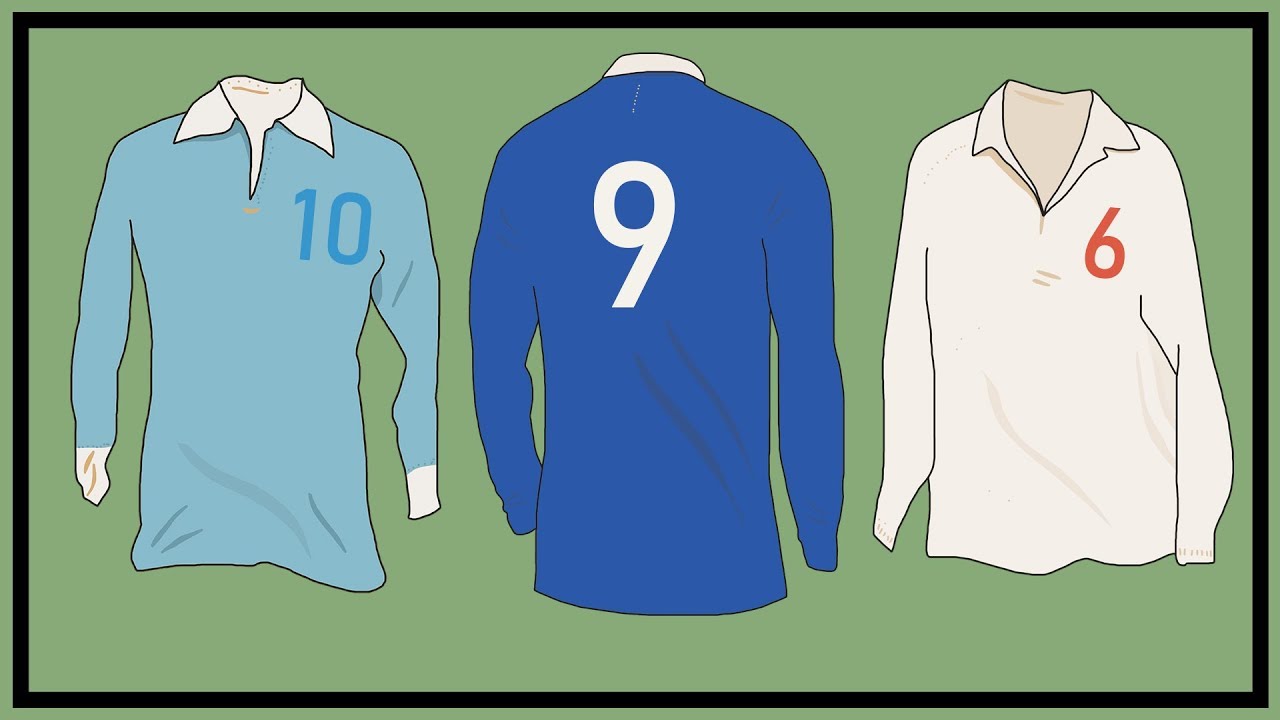
Took til 1909 for the lads to figure different color shirts was a good idea lol
Honestly l, this calms my desire to know all the why's around squad numbers that players pick. Awesome
and then we had Mohammed Kallon, striker for Inter, wearing 3
Now I have thinky pain
My favorite version is at local level and youth teams, where your shirt number is just what size your shirt is. Teams ordering off of statistical probability with smalls being 2-7, mediums being 8-16, and so on, for example.
Can we just agree to not call positions by fictitious numbers that no longer have any immediately relevance?
And then there's Italy
Why the complete silence around number 8?
As a British creator, why do you say dates in such a weird mixed way and not just the normal way? When you mix up the order it's confusing and hard to keep up.
Why did 6 drop back in England rather 4?
While I totally understand the appeal of this old position-based numbering system, I still prefer the more "freestyle" numbering we have today. 🤷
England is Europe
In championship manager, my back 4 is 2 4 6 3!
trarnsition
Fall River Marksmen mentioned 🎉🎉🎉🎉
I could watch a 3-season documentary on the numbering history in one sitting. This is fascinating
This is, by now, an older video and it treats the theme in general terms and so on, so I don't expect a lot of minute details about Brasil, nor especific ones.
In Brasil, at least in Rio, the WM did not work on the big clubs: we have been using a center-half as our ace for many years, his fuctions were mainly supporting the attack. When the hungarian coach Kürschner arrived at Flamengo, he found a very stuborn veteran called Fausto, which I would name the first WC star of Brasil (even if I am a Fluminense fan and Preguinho scored the first brazilian goal). Fausto refused to play like a full-back.
Kürschner successor in coaching Flamengo, Flávio Costa, and Fluminense 1938-43 coach, Ondino Viera (uruguaian), both implemented a defence-attack system by the way of two diagonals. One of the side half-backs would become a full-back at the side of the pitch, while the other would not. The centerhalf were dropped slightly to the front of the fullbacks, but still expected to be supporting the attack.
In some teams, the numbers also changed a bit. Fluminense's numbering were a bit different, even when the predominant tactic became the 4-2-4 (or 4-3-3, in practice): the defence line, from left to right, was numbered like this: 6 5 3 2, because the number 4 stayed with the center-half, even if he never really played as a fullback. There is mounting evidence of this in photo's of the 60's, when 4-2-4/4-3-3 was used by EVERYONE in the country.
The attack, meanwhile, followed a diagonal too and that's when the brazilian position of spearhead came to be: one of the insiders would be dropped to near the midfield, while the other would be near the attackers. The numbering of the shirts came in this stage of brazilian football, mid 1940. In most teams, on the attack side, the left insider became the spearhead, while the right one was dropped to the midfield, given a more supportive role. That's why our number 10 is mostly associated with attacking positions, like Zizinho (the first brazilian number 10) and Pelé. The number 8 was worn by the likes of Gerson and Didi, who would mostly think the game, known for deep overhead passes and great vision.
Our wingers always wore 7 (right) and 11 (left) and the centerfoward always wore the number 9.
I have always wondered why they are called "Full Backs". Now I understand.
The first FA Cup with numbering occured in the 1930s. One team came out in numbers 1-11, the opposition team had number 12-22.
Finally I understand. Thank you 🙏🏻
Here's my personal view on shirt number
GK – 1
RB – 6
CB – 4 + 3
LB – 2
CDM – 5
CAM – 7
CM – 8
LW – 10
RW – 11
ST – 9
For me, it has always been
GK 1
RB 2
Cb 4,5
LB 3
CDM 6
CM 8
CAM 10
RW 7
LW 11
ST 1
Funny story about Brazil. Here, the numbering depends on the local adaptation of the WM in the so called diagonal system. It basically depended on which half back dropped to the line and was kept more offensively . Usually it was the left half back, but occasionally it was the right half back, in which case the number of the right back was 4 and not 2, reading 6, 3, 2, 4. Just like the Argentinian case. Some Brazilian clubs, like Corinthians and Fluminense, held to this tradition right up to the '90's.
12 is the number of the og super sub
I’ve never been a fan of squad numbers I prefer the old way starting players get 1-11 and subs get the rest.
It's not uncommon in the United States for keepers to wear 0 and 00 at youth and teen levels
I'm not sure but I think it was on Euro84 that the portuguese national team mix up numbers and used a completely random number selection to confuse the man marking system of their opponents.
They've reached the semi finals and only lost against Platini's France on their home soil.
in the 1970s and early 1980s the Argentinian world cup squads were numbered alphabetically, which could look a bit weird, with goalkeepers with number 5 or 7 (Fillol) and midfield players with number 1 (Ardiles)
It’s interesting to compare with Rugby Union where the sport abandoned a brief flirtation with squad numbers in the 90s and has stuck rigidly to a position based 1-15 system ever since. Even though the positions and their numbers are not formally defined in the rules of either sport the numbers and their positions are the same worldwide in rugby union even if the names of the positions are not always the same. Tinkering with the numbers and their positions is frowned upon. Whereas even when football was 1-11 playing a number in the ‘wrong’ position was common. I remember a Nottingham Forest match where Brian Clough played his son Nigel at right back but Nigel wore 9 because that was his normal number.
Trent Alexander Arnold is a text book definition of a 66. John Terry was a key figure in the evolution of the no. 26 role. Despite being a 14, Thierry Henry was rarely a second substitute and usually started. Fabien Barthez totally re-defined the number 16 role.
When I was playing amateur football in the seventies, lads would automatically grab their favourite shirt, centre forwards would grab the 9, team loudmouth would grab the 10 and because of Best, Keegan, etc, the 7 caused a fight. I always grabbed the 11 first as nobody wanted it.
In the 70ies, 80ies and 90ies (at least) in Italy 2 was right back, 3 left back, 5 stopper (centre back) and 6 was the sweeper (Scirea, Baresi…) number 4 was a centre midfielder, usually a holding mid.
Fantastic video. You are absolutly right about the numbers in Brazil. I’m brazilian. Congratulations
Very informative, but it still doesn't touch the mystery of Liga MX numbering. Literally can choose from 000-999.
Fascinating …
“…like Fernando Redondo… okay Lucas Biglia” lmfao 😂
Funny how the first formation, 2-3-5, is very similar to what teams look like nowadays when in attack. History has come full circle
Strikers with attitude issues #45, winger converted to CM #31, winger /Striker #14, a year to late but still great propper soccer intelligence, thank you tifo, Joe devine?
a lovely piece of history
I am a goalkeeper and I use number 23
Can You Make video on Football Logos and history behind them ??……
plz reply !!!!!
lol this explains a lot of the confusion we had playing in an international school with lads from all over… had a great german defensive guy that played as '6' which, me playing goalkeeper and being from Argentina, meant that he should stayed in the defensive….and the guy just keep going back to the midfield while I screamed at him savagely to get back down….20 years later, now I know why
what number should I be? I am a very pacey right wing that has a pretty balanced style on the pitch, not a huge goalscorer but can finish if I get the oppurtunity
3:07 I think the Doncaster manager joined a band after this…😂
bale started out as a left back at spurs and retained his number when he went to left wing, always thought that was a wig out